ABOUT
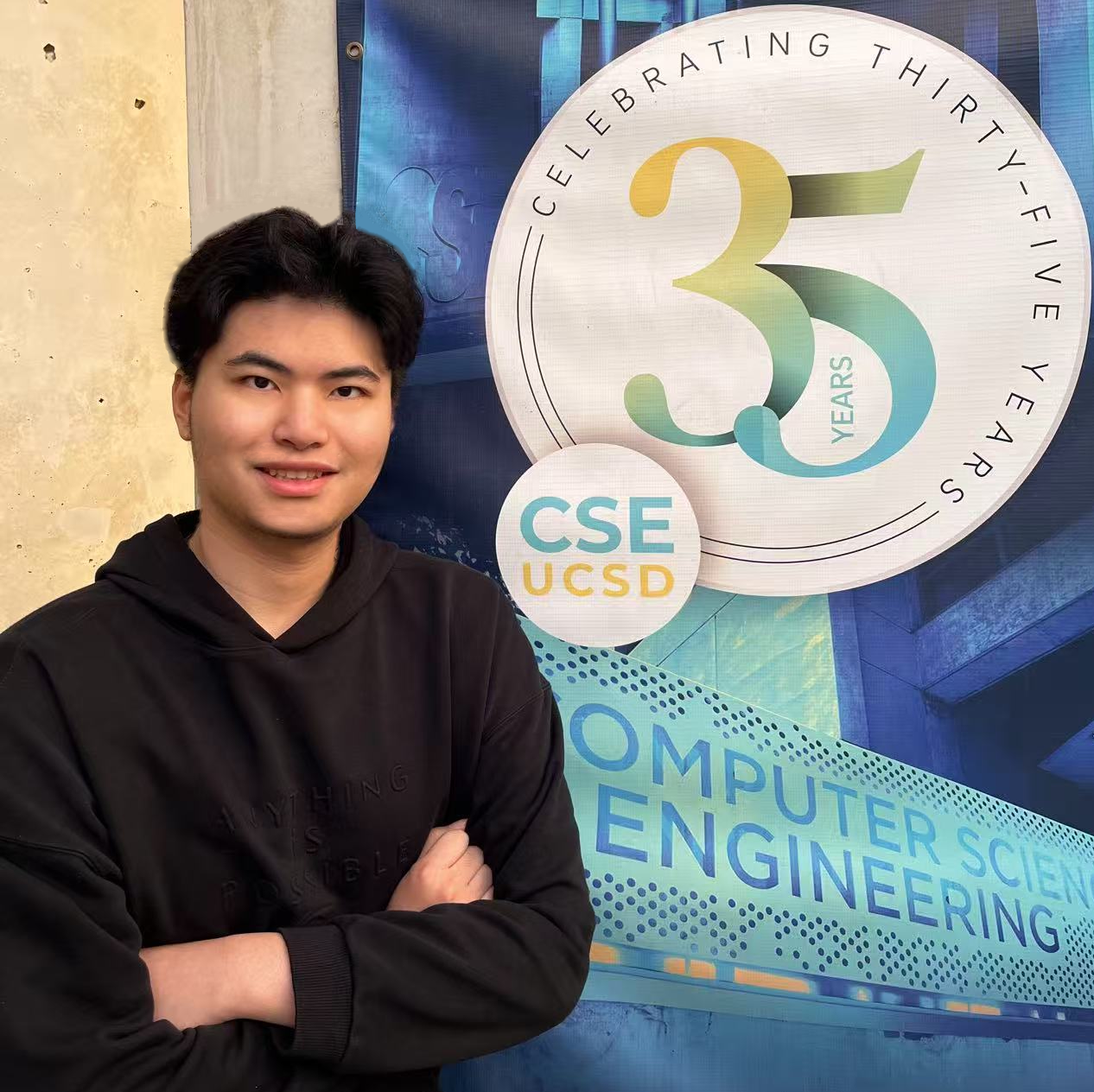
Second Year Master of Science Computer Science student in UC San Diego.
Former Computer Science and Engineering bachelor candidate, with 5 years of learning experience in data science and software engineering and proficiency in using Java, C, C++, Python, and SQL.
Based on my current MS CS study and my past BS CS experience at UC San Diego, I am committed to contributing to a dynamic and innovative work environment utilizing my extensive background in Computer Science.
I prepared myself with technical skills, demonstrating proficiency in programming languages such as Java, C++, and Python, with expertise in Python, as well as capabilities in managing large-scale projects and implementing complex algorithms.
The internship at Seres provided me with insights into collaboration and flattened communication within the workspace, as well as the practical application of automation technologies in the industry.
I developed an Android application collaboratively with a team of six aimed at enhancing communication between students on campus.
The experience of dealing with large codebase, CPython, enables me to navigate between large segments of code and adapt to a new project in a diverse environment.
I applied multiple machine learning algorithms in the projects and evaluated their effectiveness based on actual data, which has prepared me to deliver innovative solutions and drive technological advancement in professional settings.
Former Computer Science and Engineering bachelor candidate, with 5 years of learning experience in data science and software engineering and proficiency in using Java, C, C++, Python, and SQL.
Based on my current MS CS study and my past BS CS experience at UC San Diego, I am committed to contributing to a dynamic and innovative work environment utilizing my extensive background in Computer Science.
I prepared myself with technical skills, demonstrating proficiency in programming languages such as Java, C++, and Python, with expertise in Python, as well as capabilities in managing large-scale projects and implementing complex algorithms.
The internship at Seres provided me with insights into collaboration and flattened communication within the workspace, as well as the practical application of automation technologies in the industry.
I developed an Android application collaboratively with a team of six aimed at enhancing communication between students on campus.
The experience of dealing with large codebase, CPython, enables me to navigate between large segments of code and adapt to a new project in a diverse environment.
I applied multiple machine learning algorithms in the projects and evaluated their effectiveness based on actual data, which has prepared me to deliver innovative solutions and drive technological advancement in professional settings.
EDUCATION
University of California San Diego
Master of Science
- Major: Computer Science and Engineering
- Attended: 09/2024 - 06/2024
- Courses: (click to expand for more details)
-
CSE 256: Statistical Natural Language Processing
- Summary: An introduction to modern statistical approaches to natural language processing (NLP).
- Skills
- Programming Language: Python
- FeedFarwar Neural Networks
- Word Embeddings
- Tokenization
- n-Grams
- Recurrent Neural Networks (RNNs)
- Long short term memory (LSTM)
- Seq2Seq
- cross-attention
- self-attention and transformer
- Encoder and Decoder
-
CSE 202: Algorithm Design and Analysis
- Summary: An introduction to modern statistical approaches to natural language processing (NLP).
- Algorithms
- Graph Theories
- Divide and conquer
- Greedy Algorithms
- Dynamic Programming
- NP & P
-
CSE 267A: Introduction to Robotics
- Summary: An introduction to fundamentals of robotics across kinematics, sensor systems, estimation, control, and planning.
-
CSE 232B: Database System Implementation
- Summary: A hands-on approach to the principles of databases implementation. Algebraic rewriters/optimizers, query processors, triggers. Beyond centralized relational databases.
- Skills
- Programming Language: Java and SQL
- PGAdmin
- PostgreSQL
- XML
-
CSE 251A: ML: Learning Algorithms
- Summary: Algorithms for supervised and unsupervised learning from data.
-
CSE 257: Search and Optimization
- Summary: The course will cover core algorithms for sequential decision-making problems in autonomous systems. Topics include heuristic search, Monte Carlo search, deep reinforcement learning, nonlinear optimization, mixed-integer optimization, and stochastic optimization.
-
CSE 251B: Deep Learning
- Summary: This course covers the fundamentals of deep neural networks at the graduate level. We introduce multi-layer perceptrons, backpropagation, and automatic differentiation. We will also discuss convolutional neural networks, recurrent neural networks, transformers, and advanced topics in deep learning. The course will be a combination of lectures, presentations, and machine learning competitions.
-
CSE 253: Machine Learning for Music
- Summary: This course will introduce students to the application of machine learning to understand and generate music. The course will cover data structures for music representation; predictive tasks and music information retrieval; and techniques for algorithmic music synthesis.
-
CSE 291: Differentiable Programming
-
University of California San Diego
Bachlor of Science
- Major: Computer Science and Engineering; GPA: 3.84
- Attended: 09/2020 - 09/2023
- Courses: (click to expand for more details)
-
CSE 100: Advanced Data Structures
- Link: The specification in on EdStem. Log in required.
- Skills
- Programming Language: C++
- Algorithms
- Trees
- Binary Search Tree (BST)
- Self-Balancing Trees
- Multiway Trees (MWT)
- Ternary Search Trees (TST)
- Hashing
- Data compression and decompression
- Graph Theory
- Trees
-
CSE 101: Design & Analysis of Algorithm
- Link: https://cseweb.ucsd.edu/~dakane/CSE101/
- Skills
- Algorithms
- Graph Theories
- Divide and conquer
- Greedy Algorithms
- Dynamic Programming
- NP & P
- Algorithms
-
CSE 105: Theory of Computation
- Link: https://cseweb.ucsd.edu/classes/fa16/cse105-abc/
- Skills:
- Machines:
- Deterministic finite automata (DFA)
- Regular Languages and Closure
- Nondeterministic finite automata (NFA)
- Nonregular languages
- Pumping Lemma
- Context-free grammars (CFG)
- Pushdown automata
- Turing Machine (TM)
- Decidability and Undecidability
- Reduction and NP & P
- Machines:
-
CSE 107: Intro to Modern Cryptography
- Link: https://cseweb.ucsd.edu/classes/sp22/cse107-a/
- Skills:
- Programming Language: Python
- Encryption Scheme:
- Classical Encryption
- Caesar Cipher
- Substitution Cipher
- Cryptanalysis
- Perfect Security
- Block Cipher
- DES
- AES
- Game
- PRF security
- Symmetric Encryption
- ECB
- CBC
- CTR
- IND-CPA
- Hash Function
- collision
- MD Transform
- Message Authentication Code (MAC)
- UF-CMA
- Authenticated Encryption (AE)
- IND-CTXT
- Computation Theory
- group
- DH secret key exchange
- RSA
- Public-Key Encryption Scheme
- IND-CPA
- IND-CCA
- Hybrid Encryption
- key encapsulation mechanism (KEM)
- Signature
- Password and Protocols
- Homomorphic Encryption
- Zero-Knowledge Proof
-
CSE 110: Software Engineering
- Link: expired
- Skills:
- Programming Language: Java
- Project Planning
- Project Design
- Scenario-Driven Design (SDD)
- Behavior-Driven Development (BDD)
- Single Responsibility Principle
- Object Oriented Design (OOD)
- UML
- Software Testing
- Mocking
- Open-Closed Principle and Dependency Inversion
- Design Pattern
- Strategy Pattern
- Adapter Pattern
- Observer Pattern
- Creational Patterns
- Factory Method
- Builder
- Mediator and Model-View Presenter (MVP)
-
CSE 120: Princ/Computer Operating Systm
- Link: https://cseweb.ucsd.edu/classes/wi21/cse120-a/
- Skills:
- Programming Language: C++
- Operating System
- Processing
- Context switching
- Time Sharing
- Scheduling
- Synchronization
- Inter-Process Communication (IPC)
- Deadlock
- Memory Management
- Logical Memory
- File System
- Input/Output System
-
CSE 132A/CSE 132B: Database System Principles/Applications
- Link: canvas page
- Skills:
- Programming Language: SQL and Java
- Database Management System (DBMS):
- Relational Data Model
- SQL:
- Data Definition Language (DDL)
- Data Manipulation Language (DML)
- Recursion
- Java Database Connectivity (JDBC)
- Query Processing
- Schema Design
-
CSE 134B: Web Client Languages
- Link: canvas page
- Skills:
- Programming Language: HTML, CSS, and JavaScript
- Project:
- Link: https://github.com/crickwang/cse134-hw5
- Website: https://tranquil-queijadas-5b97c9.netlify.app (Domain expired)
-
CSE 140/CSE 140L: Component & Design Tech/Digital Sys / Digital Systems Laboratory
- Link: None
- Skills:
- Programming Language: System Verilog
- Hardware Theory:
- Transistors
- Logic gates
- Mux/Demux, decoder, and adder
- ALU
- Latches and Flip Flop (FF)
- RTL Design
- Memory
- CPU Design
- Hardware Design
-
CSE 141/CSE 141L: Intro/Computer Architecture / Project/Computer Architecture
- Link: https://patpannuto.com/classes/2020/fall/cse141/
- Skills:
- Programming Language: System Verilog
- ISA Design:
- Single Cycle Machines:
- Operations
- Performance
- Datapaths and Control paths
- Multi-cycle Machines:
- Pipeline
- Branch Predictor
- Exceptions and interruptions
- Cache and Memory:
- Virtual Memory
- Single Cycle Machines:
- Self-designed MIPS-like instruction set
-
CSE 150B: AI: Search and Reasoning
- Link: None
- Skills:
- Programming Language: Python
- Searching Algorithms:
- DFS/BFS
- A*
- Adversarial Search
- Markov Decision Process
- Reinforcement Learning:
- Monte Carlo policy evaluation
- Temporal difference
- Constraint solving
-
CSE 151A: Intro to Machine Learning
- Link: https://shangjingbo1226.github.io/teaching/2021-spring-CSE151A-ML
- Skills:
- Programming Language: Python
- Algorithms:
- Nearest Neighbor Classification
- KNN
- Gradient Descent
- Regression:
- Least-squares regression
- Logistic regression
- Perceptron
- Overfitting and regularization
- Support Vector Machine (SVM)
- Naive Bayes
- Decision Trees
- Random Forest
- Ensemble:
- Bagging
- Boosting
- Multi-class classification
- Neural Networks:
- Convolutional Neural Networks (CNN)
- Semi-supervised Learning
- Nearest Neighbor Classification
-
CSE 151B: Deep Learning
- Link: https://sites.google.com/view/cse151b
- Skills:
- Programming Language: Python
- Algorithms:
- Multi-layer Perceptron (MLP)
- Convolutional Neural Network (CNN)
- Recurrent Neural Network (RNN)
- Attention
- Transformer
- Project
-
CSE 158: Recommender Systems & Web Mining
- Link: https://cseweb.ucsd.edu/classes/fa19/cse158-a/
- Skills:
- Programming Language: Python
- Supervised Learning:
- Classification
- Clustering
- Recommender system
- Text mining
- Data mining
- Project
-
CSE 190: Topics in Computer Science & Engineering - Large Codebase Construction and Management
- Link: https://cse190largecodebases.github.io/
- Skills:
- Programming Language: Python
- Large Codebase (CPython)
- Diagramming
- Debugger
- Unit Testing
- Git workflow
- Project
-
CSE 250A: Principles of Artificial Intelligence: Probabilistic Reasoning and Decision-Making
- Link: None
- Skills:
- Programming Language: Python
- Algorithms:
- Graph theory
- Conditional independence and d-separation
- Inference:
- Node clustering
- Cutset conditioning
- Likelihood
- Markov chain and Monte Carlo Method
- Maximum likelihood
- Naive Bayesian
- Regression
- Gradient descent and Newton's method
- EM algorithm
- Viterbi Path
- Forward-backward algorithms
- Gaussian mixture
- Reinforcement learning
-
PROFESSIONAL EXPERIENCE
Sino-Tech Cloud Innovation Tech Co., Ltd.
- Position: Research Intern
- Period: 07/2025 - 08/2025
- Responsibilities:
- Developed real-time communication (RTC) platform integrating WebRTC with AI agents, transforming text-to-speech-only virtual agent into interactive real-time conversational agent.
- Built conversational pipeline using both external APIs (e.g., Google STT/TTS) and locally deployed open-source models (e.g., FunASR), reducing operational costs by 85% from around $100/1M input and output tokens based on OpenAI’s Realtime to less than $15/1M tokens.
- Adopted peer-to-peer communication architecture using WebRTC, eliminating server-centered audio processing and reducing end-to-end latency by 98% from ~120 seconds (TCP-based WebSocket) to ~2 seconds (UDP-based WebRTC streaming).
- Deployed application on AWS and Aliyun cloud platforms, eliminating physical server maintenance and hardware costs while enabling automatic scaling.
Seres Group Co., Ltd.
- Position: Testing Engineer Intern
- Period: 03/2024 - 06/2024
-
Responsibilities:
- Engineered and maintained an Over The Air (OTA) platform enabling software updates, diagnostics, and bootloading via cloud. Enhanced user control by allowing management of vehicle components, software versions, and data through mobile devices.
- Co-developed a Python interface for the OTA platform and integrated it with CANoe software, focusing on automating ECU component tests, vehicle strategy deployments, and task management.
- Performed ECU testing for autopilot systems utilizing CANoe software. Conducted thorough testing on a web application to ensure correct signal transmission to the vehicle based on user actions. Developed and refined test cases collaboratively with teammate following the testing requirements filled by the development team.
- Performed ECU testing for autopilot systems using CANoe. Developed new test cases and refined existing ones in collaboration with a team under supervisor's guidance.
-
Contributions and Achievements:
- Gained comprehensive expertise in ECU testing and automotive protocols, mastering CANoe software and CAPL programming within one month. Rapidly gained experience in software testing in the auto industry.
- Contributed to the development of new vehicle models SF5 and M9 at Seres Corporation, experiencing the full life cycle of automotive software development from hardware implementation. Enhanced collaboration among team members and committed to facilitating cross-departmental cooperation, overcoming challenges related to confidentiality constraints.
- Spearheaded the automation of test case initialization using Python scripts, reducing setup time from 10 minutes to a few lines of code. Endorsed by coworkers and supervisors for significantly reducing team workload and enhancing project efficiency. Accelerated the development of similar test case setups in future projects by implementing robust software design principles, making the code reusable and scalable.
- Achieved a 99.7% pass rate on automated test cases under pressure test, surpassing the target of 97% and demonstrating exceptional performance in quality control.
SKILLS
- Programming Languages: Python, C++, Java, SQL, CAPL, HTML, CSS, JavaScript, Shell Scripting.
- Artificial Intelligence: Neural Networks, Reinforcement Learning, Machine Learning, Deep Learning, Supervised Learning, Unsupervised Learning, CNN, LSTM (RNN), Transformer, Natural Language Processing, Optimization, Computer Vision, TensorFlow, PyTorch.
- Software Engineering: Design Patterns, UML, Agile Methodologies, Software Testing, Version Control (Git), CI/CD, Code Review.
- Data Structures & Algorithms: Searching, Sorting, Advanced Trees, Hashing, Graph Theory, Complexity, Dynamic Programming, Greedy Algorithms.
- Web Development: HTML, CSS, JavaScript, React, Node.js, WebSocket, WebRTC, Frontend and Backend Development, HTTP/HTTPS, Peer-to-Peer and Client-Server Network, TCP/IP, UDP.
- Operating System: Virtual Machines (Ubuntu), Linux, Shell Scripting, File System.
- Database Management System (DBMS): SQL, PostgreSQL, Query Optimization, PGAdmin, Database Design.
- Recommender System & Web Mining: Filtering, Matrix Factorization, Feature Engineering, A/B Testing, Similarities, Behavior Analysis.
PROJECT EXPERIENCE
Project 1: UCSD Campus Networking APP
Lead Android Developer
- Overview: Initiated and developed an Android application aimed at revolutionizing student communication at UCSD. The app was designed to address the challenge of fostering student interactions in a large campus setting. By utilizing Bluetooth technology and location-based services, the app allowed students to effortlessly discover and connect with peers nearby, encouraging real-time communication and networking.
- Responsibilities:
- Project Leadership: Led the development team of 3, fostering a collaborative and diverse work environment to enhance the app's functionality and accessibility.
- Technical Development: Executed the design and implementation of critical features using Android Studio, incorporating Bluetooth-based discovery systems and Google Nearby API for efficient device detection.
- SDLC Compliance: Adhered to all stages of the Software Development Lifecycle, ensuring the delivery of a reliable and high-quality software product.
- UI Design & Enhancement: Developed a user-friendly interface, integrating advanced features such as a secure Google sign-in system to create a dynamic and engaging user experience.
- Achievements:
- Enhanced Campus Connectivity: Successfully launched an app that established solid peer connections between different devices.
Project 2: New York Taxi Fare Prediction
Data Scientist
- Overview: Aimed at predicting taxi fare amounts in New York City, this project leveraged a variety of machine learning models to estimate costs based on pickup and dropoff locations.
- Responsibilities:
- Machine Learning Modeling: Employed KNN, naive Bayes, and linear regression algorithms to develop base prediction models.
- Deep Learning Enhancement: Integrated a multi-layer perceptron (MLP) to refine the predictive power of the ensemble model and achieve better accuracy.
- Model Evaluation: Used Root Mean Square Error (RMSE) as the metric for performance evaluation.
-
Achievements:
- Model Accuracy: Achieved a competitive RMSE score of 3.5, indicating high accuracy in predicting taxi fares.
Project 3: Housing Selections Recommendation APP
Backend System Developer
- Overview: Tasked with creating an innovative recommender system for a mobile application, this project aimed to significantly improve the housing selection process for UCSD off-campus students by providing personalized and efficient housing recommendations based on user preferences and property characteristics.
- Responsibilities:
- Recommender System Development: Solely designed and executed a recommender system that intuitively matched students' housing needs with available properties.
- Data Preprocessing with SQL: Employed advanced SQL queries for the accurate and detailed preprocessing of diverse well-collected data, ensuring high-quality input for the recommendation algorithm.
- Algorithm Design and Implementation: Developed and implemented a recommendation algorithm using the cosine similarity metric, enhanced by regularization techniques for precise matching of user preferences and housing attributes.
- Collaboration with Development Teams: Collaborated effectively with front-end developers to integrate the recommender system into the application, focusing on a seamless user interface and experience.
- Achievements:
- System Impact on Housing Search: Developed a recommender system that reduced the average time people spent searching for housing by 30%, significantly streamlining the housing selection process.
- User Engagement Improvement: Post-implementation, user engagement with the housing application increased by 25% in testing, indicating higher user satisfaction and system utility.
Project 4: Culinary Insight Project
Data Analyst
- Overview: The 'Culinary Insight' project was an initiative focused on leveraging advanced data analytics to enhance the dining experience. The primary goal was to analyze large sets of customer feedback and ratings data to understand student preferences better and improve the overall quality of campus dining services.
- Responsibilities:
- Data Preprocessing and Visualization: Conducted thorough preprocessing of extensive datasets using Python libraries and visualized data patterns using matplotlib and seaborn.
- Correlation Analysis: Performed statistical analysis to determine correlations between customer attributes and restaurant ratings using Ordinary Least Squares (OLS) for insightful variable analysis.
- Predictive Modeling: Developed predictive models using Linear Regression, Random Forest, and Naive Bayes algorithms to forecast restaurant ratings based on customer data.
- Recommendation System Development: Created a Jaccard Similarity-based recommendation system to predict restaurant ratings by aligning customer profiles with historical rating trends.
- Achievements:
- Recommendation System Success: The Jaccard Similarity-based system increased the accuracy of matching customer preferences with restaurant offerings by 35%, elevating customer satisfaction and loyalty.
- Correlation Analysis Insights: Provided actionable insights through correlation analysis, leading to a 20% enhancement in the restaurant selection process, validated by customer feedback and increased engagement.
Project 5: "TaxiTime" Project
Machine Learning Scientist
- Overview: The 'TaxiTime' project focused on analyzing an extensive dataset of taxi trip information with the objective of employing deep learning techniques to accurately predict trip durations. The initiative aimed to enhance ride scheduling and operational efficiency in urban transport systems.
- Responsibilities:
- Algorithm Development: Employed Multi-layer Perceptrons (MLP) to create a foundational neural network for initial duration predictions.
- Model Augmentation: Integrated a combination of classical machine learning algorithms (linear regression, naive Bayes, random forest, LightGBM) into the MLP framework to improve predictive accuracy, focusing on optimizing model weights for refined duration forecasts.
- Training and Optimization: Managed extensive model training sessions, utilizing 100 epochs over 30 minutes to ensure convergence to the most effective model parameters.
- Achievements:
- Predictive Model Innovation: Developed a hybrid predictive model that improved the accuracy of trip duration forecasts by 40%.
- Efficiency in Model Training: Achieved model convergence within a shortened timeframe, reducing computation resources by 25% while maintaining high accuracy in predictions.
Project 6: UCSD WebReg Replica for Course Enrollment
Data Scientist
- Overview: Endeavored to replicate UCSD's official course enrollment platform, WebReg, this project entailed creating a comprehensive web-based system replicating its functionalities. Utilized a robust stack comprising HTML, CSS, JavaScript, Java (JDBC), and SQL.
- Responsibilities:
- Database Architecture: Engineered and supervised a PostgreSQL database, managing it via pgAdmin. Ensured seamless integration with the web interface through JDBC.
- Data Stewardship: Administered database operations in PostgreSQL, ensuring data integrity and implementing constraints via SQL commands. Delivered bespoke course enrollment information based on diverse student criteria.
- Comprehensive Testing: Implemented various testing methodologies, including mocking, to validate functionalities like course modifications and manipulations.
- Achievements: Successfully emulated WebReg's capabilities, receiving commendations for operational excellence during the project's culmination presentation.
Project 7: Innovative Web Design Initiative
Front End Developer
- Overview: Orchestrated the creation of a dynamic website, intricately blending HTML, CSS, and JavaScript to showcase personal and UCSD-centric narratives.
- Responsibilities:
- HTML Craftsmanship: Executed foundational web development using HTML5, incorporating interactive elements like links, imagery, and multimedia.
- Engaging User Interface: Designed and implemented interactive elements for enhanced user engagement, utilizing CSS and JavaScript for aesthetic and functional enhancements.
- Intuitive UI Layout: Crafted a user-centric interface, prioritizing ease of navigation and visual appeal.
Project 8: CPython Codebase Expansion and Management
Software Engineer
- Overview: This endeavor focused on augmenting the existing CPython codebase, a cornerstone for advanced Python programming. The objective was to integrate new features and maintain a streamlined management system.
- Responsibilities:
- Codebase Analysis: Employed comprehensive tools for codebase evaluation, reconstructing inefficient segments for enhanced performance.
- Innovative Feature Integration: Devised and embedded novel functionalities to improve the coding experience, ensuring harmonious coexistence with existing CPython features.
- Rigorous Testing: Developed tailored demonstrations to simulate user interactions, preparing for and rectifying unconventional user behaviors.
- Achievements: Elevated programming efficiency significantly, evidenced by peer reviews and user testimonials.
Project 9: MIPS Architecture Advancement
Hardware Architect
- Overview: Pioneered the design and implementation of an innovative MIPS-like instruction set and assembly codes, streamlining MIPS architecture by omitting superfluous instructions.
- Responsibilities:
- Hardware Blueprinting: Utilized ModelSim and Quartus for visualizing and planning hardware structure and workflow.
- Assembly Language Innovation: Formulated and applied a customized instruction set, optimizing assembly instructions for multi-cycle machines.
- Memory Management Revamp: Overhauled memory management protocols, enhancing the instruction memory to ALU cycle and crafting expedited pathways for branch instructions.